
Outcall Services in Panama City: A Local Guide to Discreet Coordination
Adult Entertainment in Central America: What You Should Know 2026
Prostitution in Panama: A Legal and Cultural Perspective
How law, health oversight, migration, tourism, and enforcement shape Panama’s regulated adult sex-work landscape.
Prostitution in Panama occupies a distinct position in Latin America. Independent adult sex work is generally treated as legal and regulated, while trafficking, coercion, exploitation, forced prostitution, and any involvement of minors remain criminal matters.
The practical reality is more complex than the legal category alone. Panama has a formal sector connected to health oversight and administrative controls, but a larger informal market also exists. That informal sector is shaped by migration pressure, economic vulnerability, tourism demand, digital advertising, and uneven enforcement capacity.
This article examines Panama’s sex-work framework from a legal, public-health, migration, and cultural perspective. It does not treat the market as uniform. Instead, it separates the regulated adult sector from informal activity and from criminal exploitation, because each raises different legal, health, and social concerns.
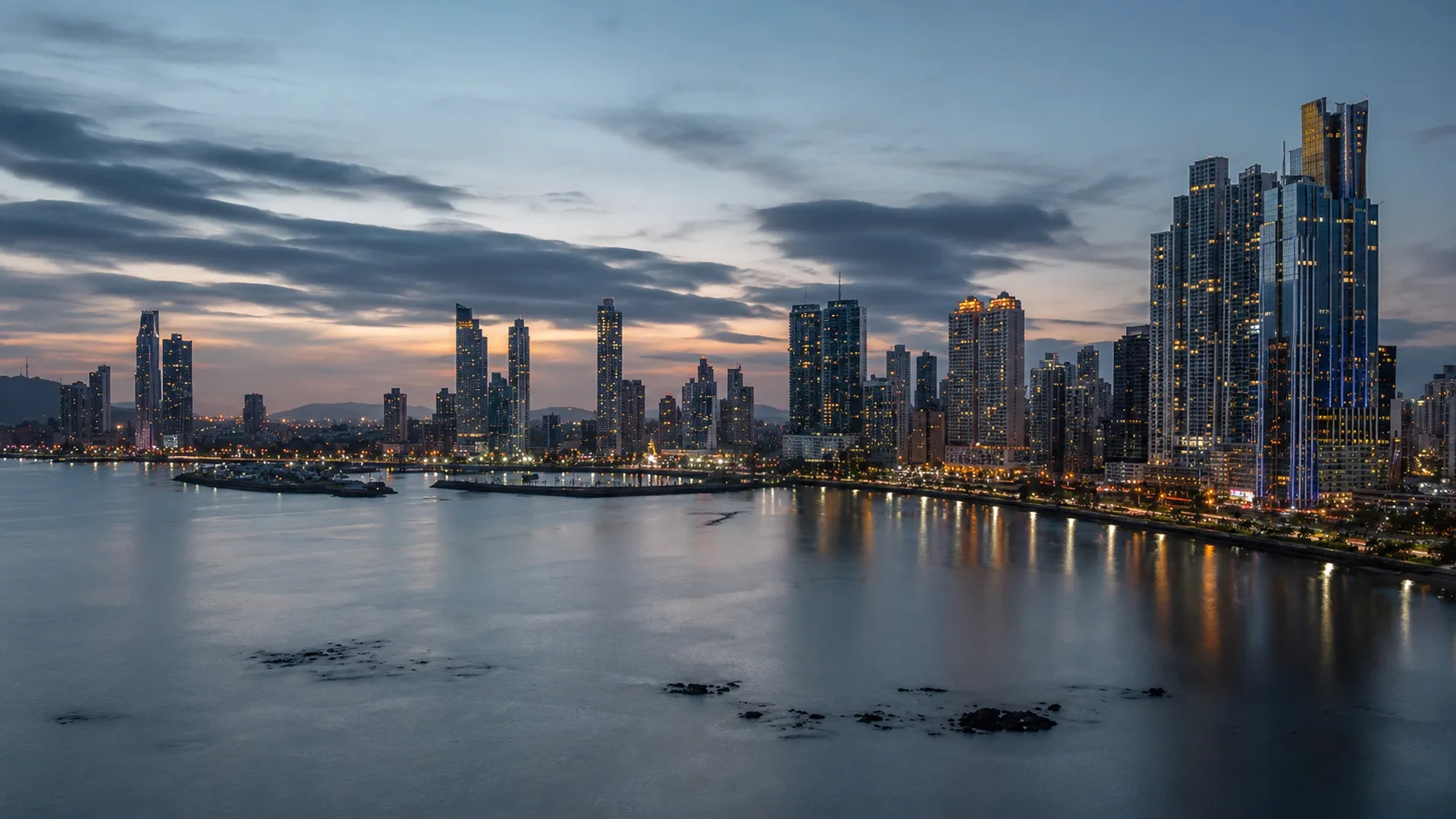
The Dual Structure of Panama’s Sex Industry
Panama’s adult sex-work market is best understood as a dual structure. One side is connected to administrative regulation and public-health oversight. The other operates informally, often through private contacts, nightlife settings, online advertising, migration networks, or unregistered arrangements.
Health oversight and administrative control
The formal sector is associated with registration or health-monitoring systems where applicable. This can create a degree of visibility for public-health authorities, but it does not cover the entire market and does not automatically provide full labour protection.
Less visible and more vulnerable
The informal sector is harder to measure and may include migrants, private workers, street-based activity, or online arrangements. Reduced visibility can increase vulnerability around healthcare access, police contact, exploitation risk, and legal uncertainty.
The distinction matters because “legal” does not mean fully protected, and “informal” does not automatically mean criminal. Panama’s model separates consensual adult activity from exploitation offences, but the practical outcome depends heavily on registration access, migration status, enforcement behaviour, and whether a worker can safely report abuse.
The strongest interpretation for readers is this: Panama does not operate as a simple fully legalised market. It operates as a partially regulated adult sex-work environment with a significant informal layer and a separate criminal framework for trafficking, coercion, and exploitation.
Historical Context
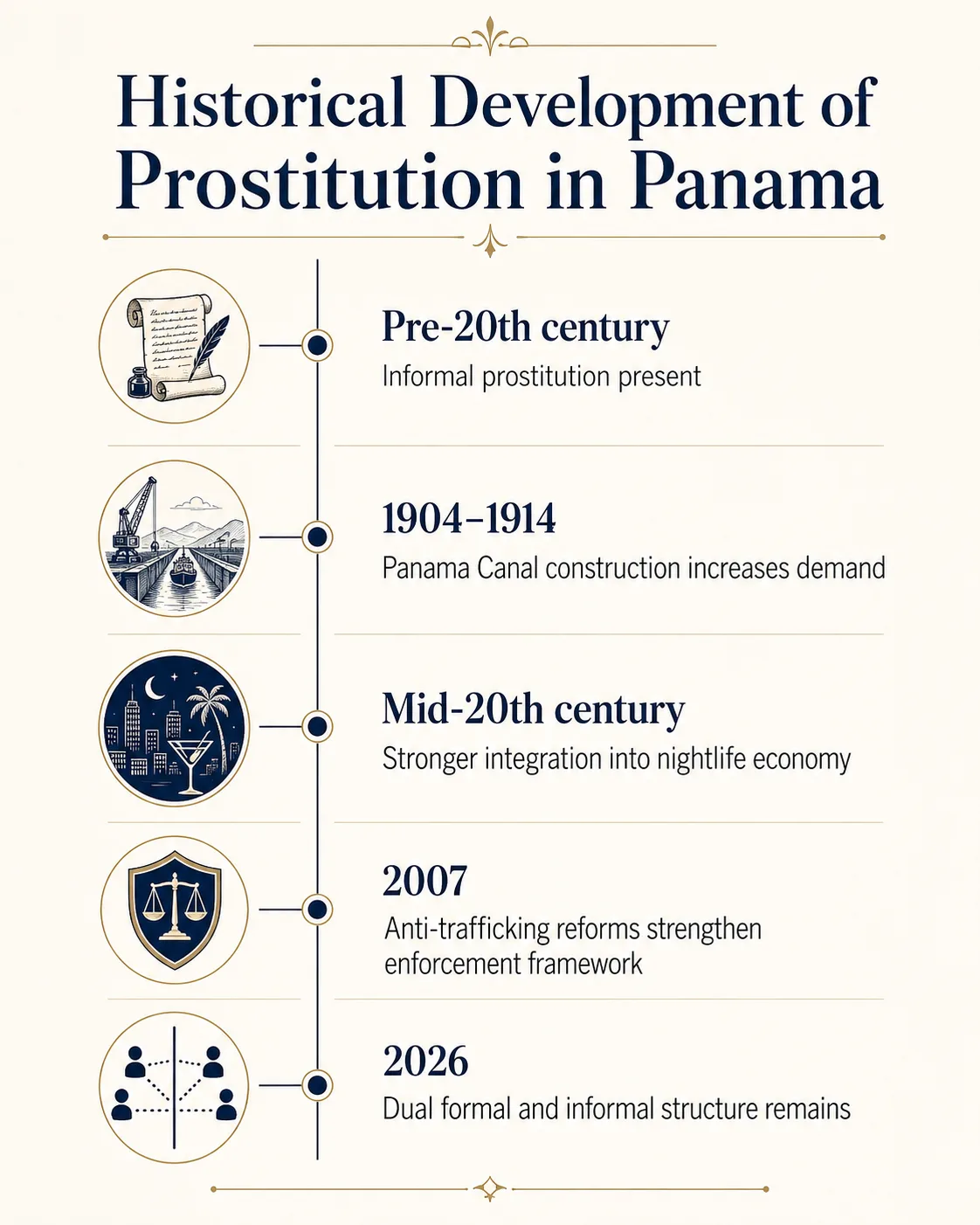
The modern visibility of prostitution in Panama is closely tied to the country’s role as a transit corridor, port economy, and international labour hub. The most important historical turning point was the Panama Canal construction period between 1904 and 1914, when large-scale labour migration reshaped Panama City, Colón, and surrounding commercial districts.
Canal-era migration did not create adult sex work in Panama, but it increased visibility around labour camps, ports, nightlife corridors, and urban service economies. Authorities increasingly treated prostitution as a public-health and order-management issue rather than only as a morality question.
That early regulatory instinct still matters. Panama’s later model developed around a practical divide: some activity became visible to health and administrative systems, while other activity remained informal and harder to supervise.
By the mid-twentieth century, prostitution had become connected to nightlife, migration, tourism, and the broader service economy. As Panama evolved into a financial, logistics, and travel hub, the adult-entertainment market continued to reflect wider patterns of movement, inequality, and urban demand.
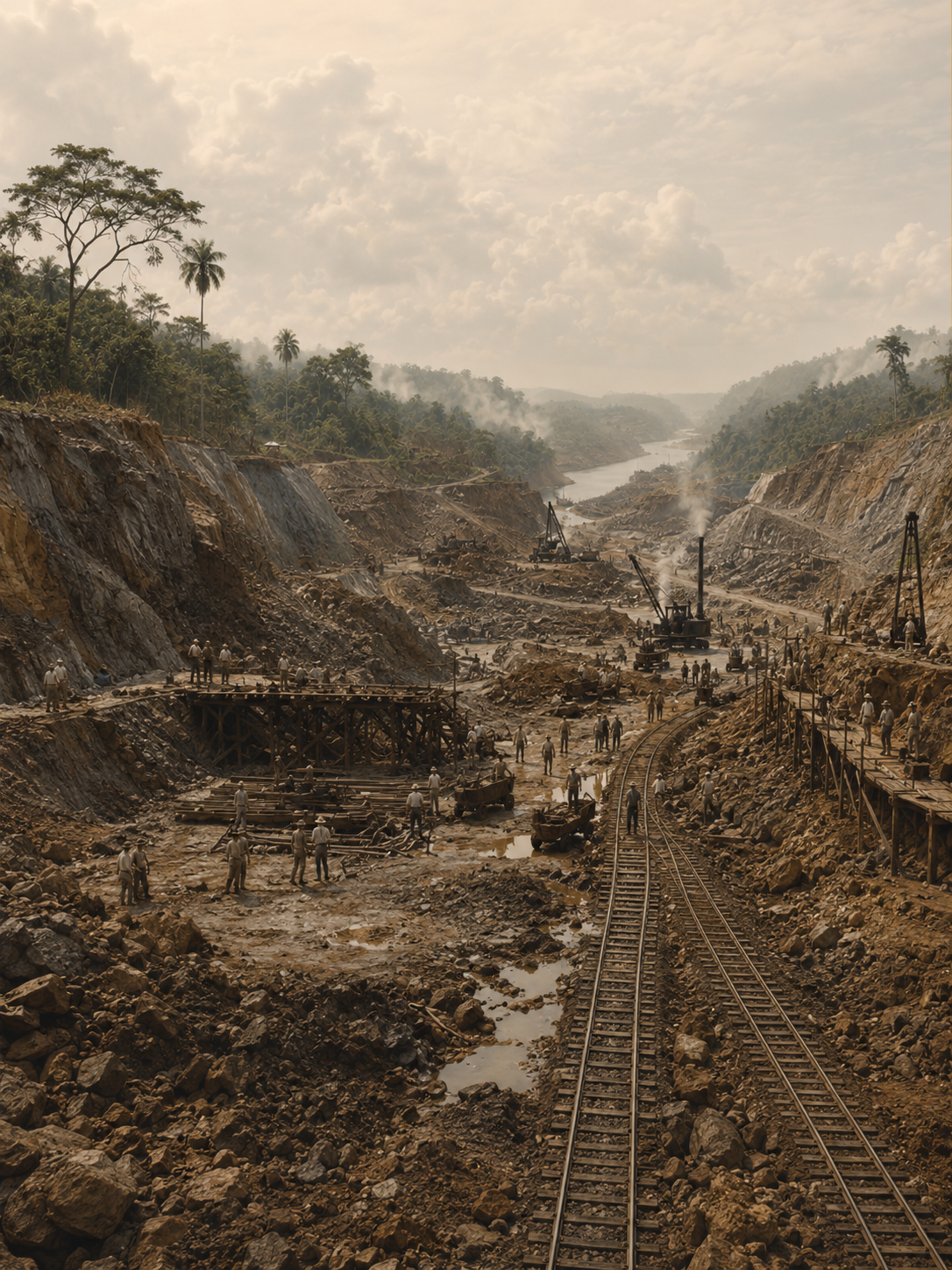
How the Panama Canal shaped early regulation
The canal period brought rapid urban growth, foreign labour movement, and public-health concerns. Those conditions helped shape the early supervision model that later influenced Panama’s formal-sector approach.
Recent Statistics and Demographics
Migration is one of the clearest demographic patterns in Panama’s adult sex-work market. Panama’s role as a regional transit point, financial centre, tourism destination, and service economy attracts workers from across Latin America and the Caribbean.
Reported estimates have suggested that foreign nationals make up a large share of the sex-work population, with Colombia, Venezuela, the Dominican Republic, and Nicaragua often appearing in regional discussions. Exact figures remain difficult to verify because a significant part of the market operates outside formal registration.
This matters because migration status can affect access to healthcare, legal protection, housing, formal employment, and the ability to report exploitation. The same legal framework can produce very different outcomes for registered workers and those operating informally.
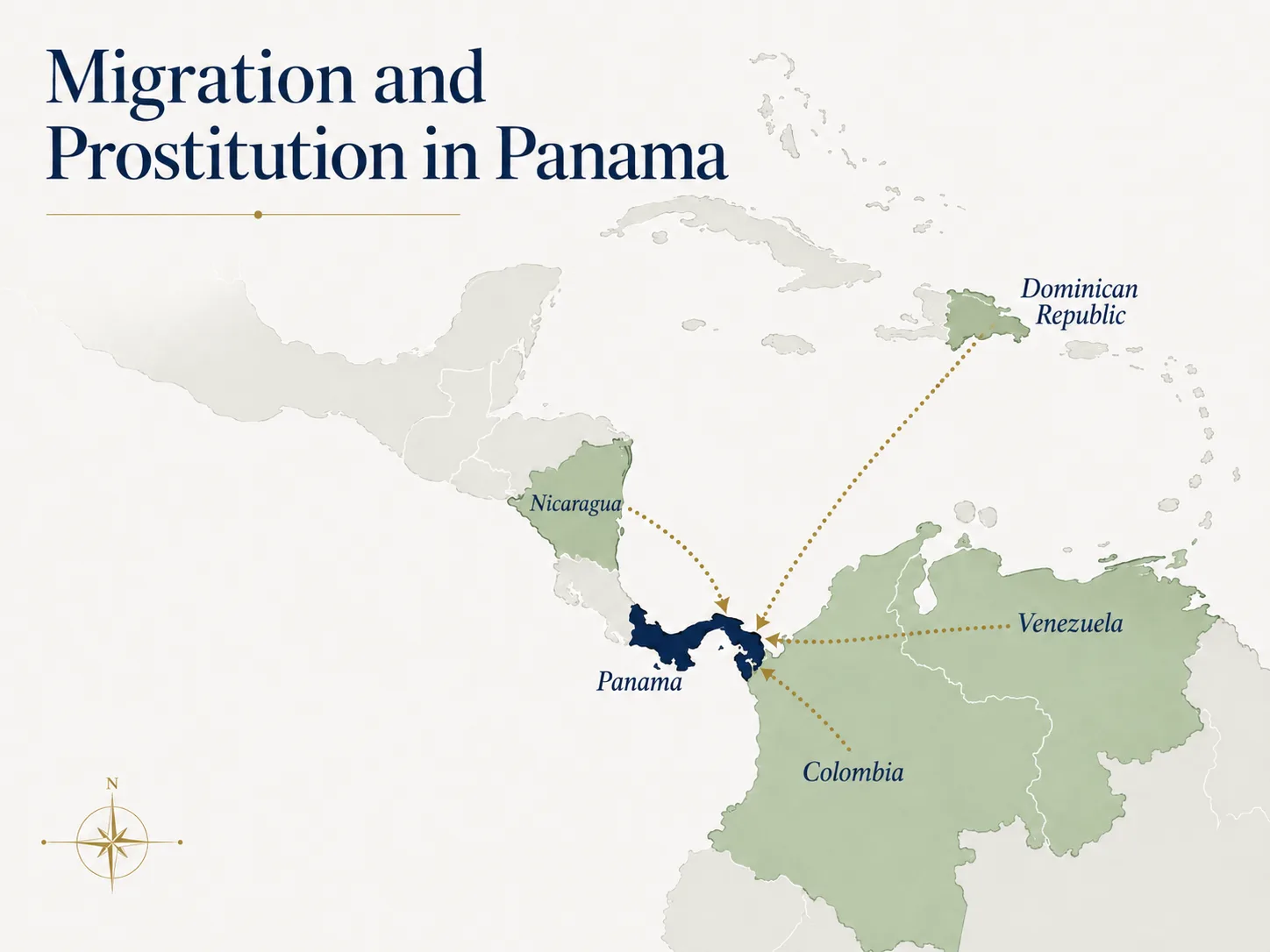
Key Factors Behind Migration into Panama’s Sex Industry
- Regional economic pressure: limited employment opportunities can push migrants toward informal labour markets.
- Cross-border movement: Panama’s transit role attracts workers from across Latin America and the Caribbean.
- Informal-sector vulnerability: unregistered workers may face reduced access to healthcare, legal support, and safer working conditions.
- Tourism and urban demand: Panama City’s hospitality, nightlife, and travel economy contribute to the visibility of the industry.
Health and Safety Measures
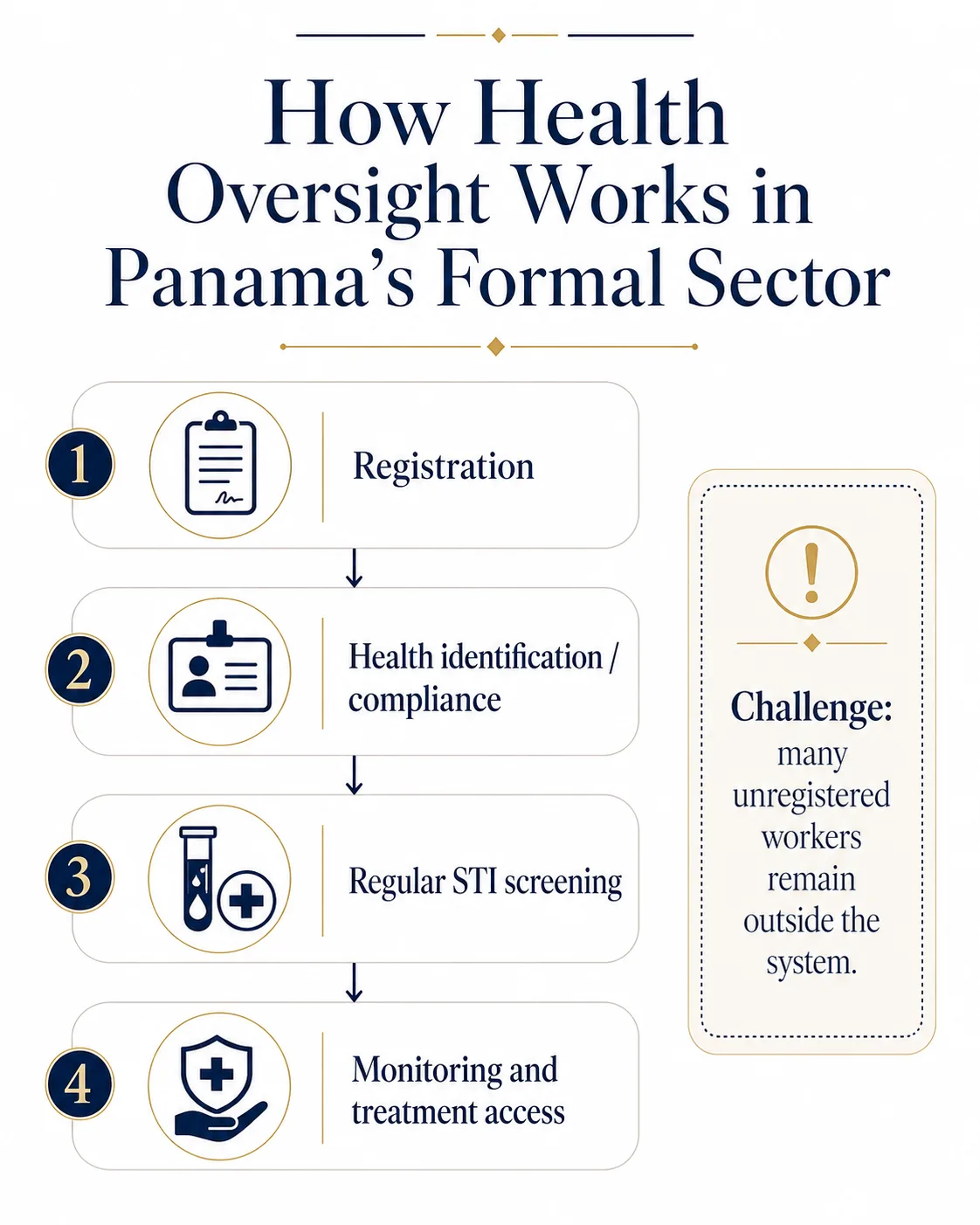
Public health oversight is one of the most structured parts of Panama’s regulatory model. Registered workers may come into contact with screening and monitoring systems designed to reduce STI transmission and improve public-health visibility.
The problem is coverage. Many workers remain outside formal systems because of stigma, migration concerns, financial barriers, lack of trust, or fear of administrative consequences. As a result, health oversight is strongest in the formal sector and weaker in the informal market.
Reported HIV and STI figures should be treated as estimates rather than fixed universal numbers. Rates vary by study, population group, year, access to testing, and methodology. For readers, the more important point is that access to testing and treatment is uneven.
Anonymous testing, outreach services, culturally sensitive education, mobile health support, and easier treatment access remain important complements to registration-based systems, especially for workers outside formal oversight.
Legal Framework and Enforcement
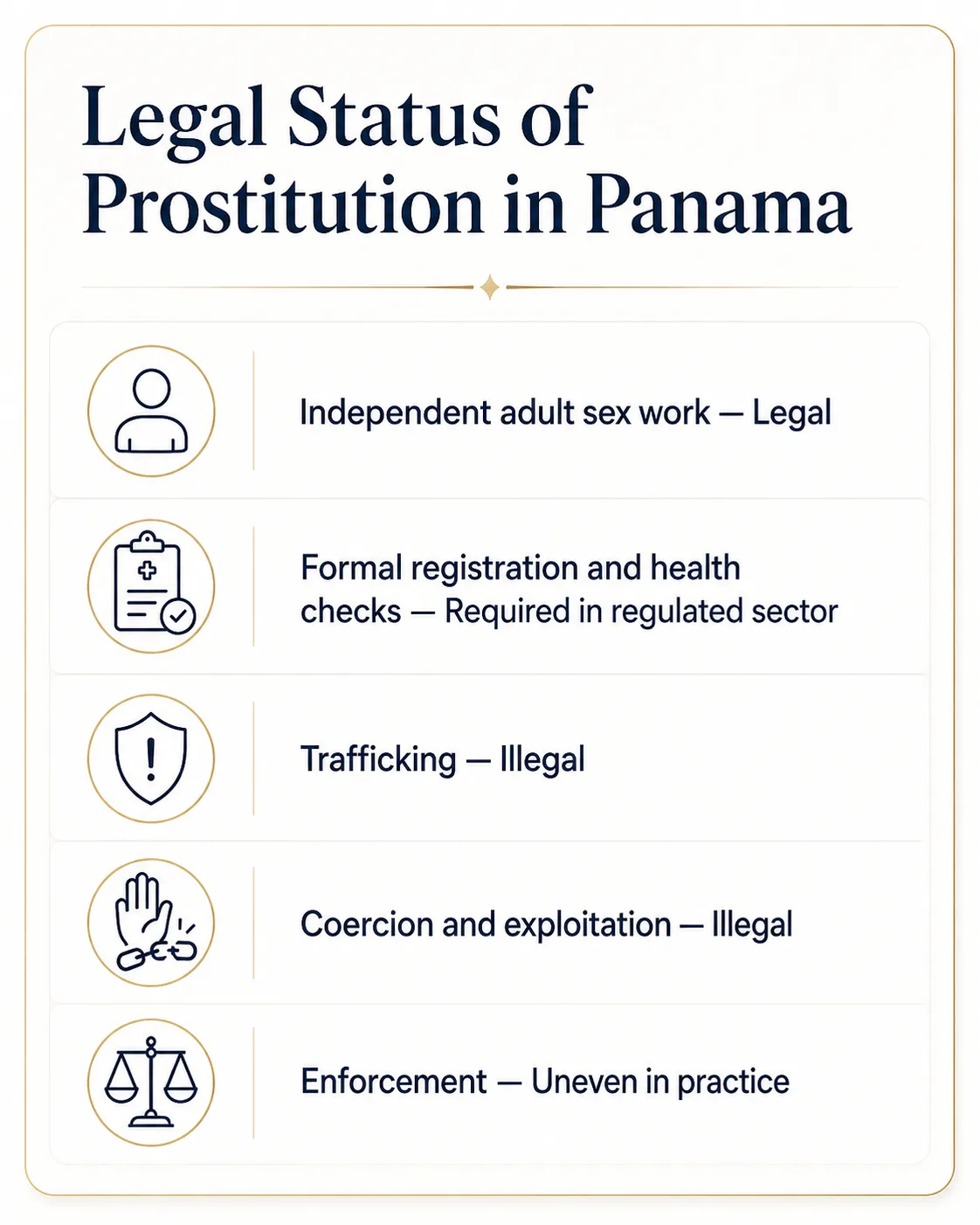
Panama’s legal framework draws an important distinction between consensual adult sex work and exploitation. Independent adult activity is treated differently from trafficking, coercion, forced prostitution, exploitative third-party control, and any involvement of minors.
This distinction is central to understanding the country’s model. Panama does not legalise exploitation. Instead, it permits or regulates parts of the adult market while relying on criminal law, enforcement agencies, victim-protection systems, and public-health authorities to address abuse and trafficking risk.
In practice, enforcement can be uneven. Institutional capacity, under-reporting, migration status, fear of deportation, corruption concerns, and the difficulty of monitoring informal arrangements all affect how the framework operates on the ground.
Recent anti-trafficking reforms have strengthened Panama’s formal legal position. Even so, the most important practical question is not only what the law says, but whether workers can access protection, whether victims can report exploitation safely, and whether authorities can distinguish consensual adult activity from coercive or abusive conduct.
Editorial note: Panama’s anti-trafficking framework has been updated in recent years. Legal penalty details, visa categories, and enforcement rules should be reviewed periodically against current official sources before being treated as fixed guidance.
Economic and Cultural Influences
Panama’s economy has gone through periods of rapid expansion, especially around finance, logistics, construction, tourism, and international services. That growth has helped position Panama City as one of the region’s most important business and hospitality centres.
But economic growth does not remove informal labour pressure. The adult-entertainment market sits beside wider structural issues: migration, income inequality, limited access to secure work, nightlife demand, and the gap between formal regulation and informal survival economies.
This is why Panama’s sex-work landscape should not be viewed only through nightlife or tourism. It also reflects broader labour-market realities. Some arrangements occur in discreet, higher-end private environments; others remain informal, less protected, and more vulnerable to exploitation or poor health access.
Economic Disparity as a Structural Driver
National growth does not always translate into stable formal employment for vulnerable groups.
Limited access to secure work can push people toward informal labour, including commercial sex.
Foreign workers may rely on informal markets when legal, documented, or stable employment options are limited.
Online platforms can create more direct client-worker contact, but oversight, screening, and accountability remain limited.
Panama City’s hotels, nightlife, business travel, and private social environments contribute to demand across different parts of the market.
Regulation exists, but much of the market remains informal, unlike countries with highly structured licensing systems or formal red-light districts.
Growth does not remove informal labour pressure
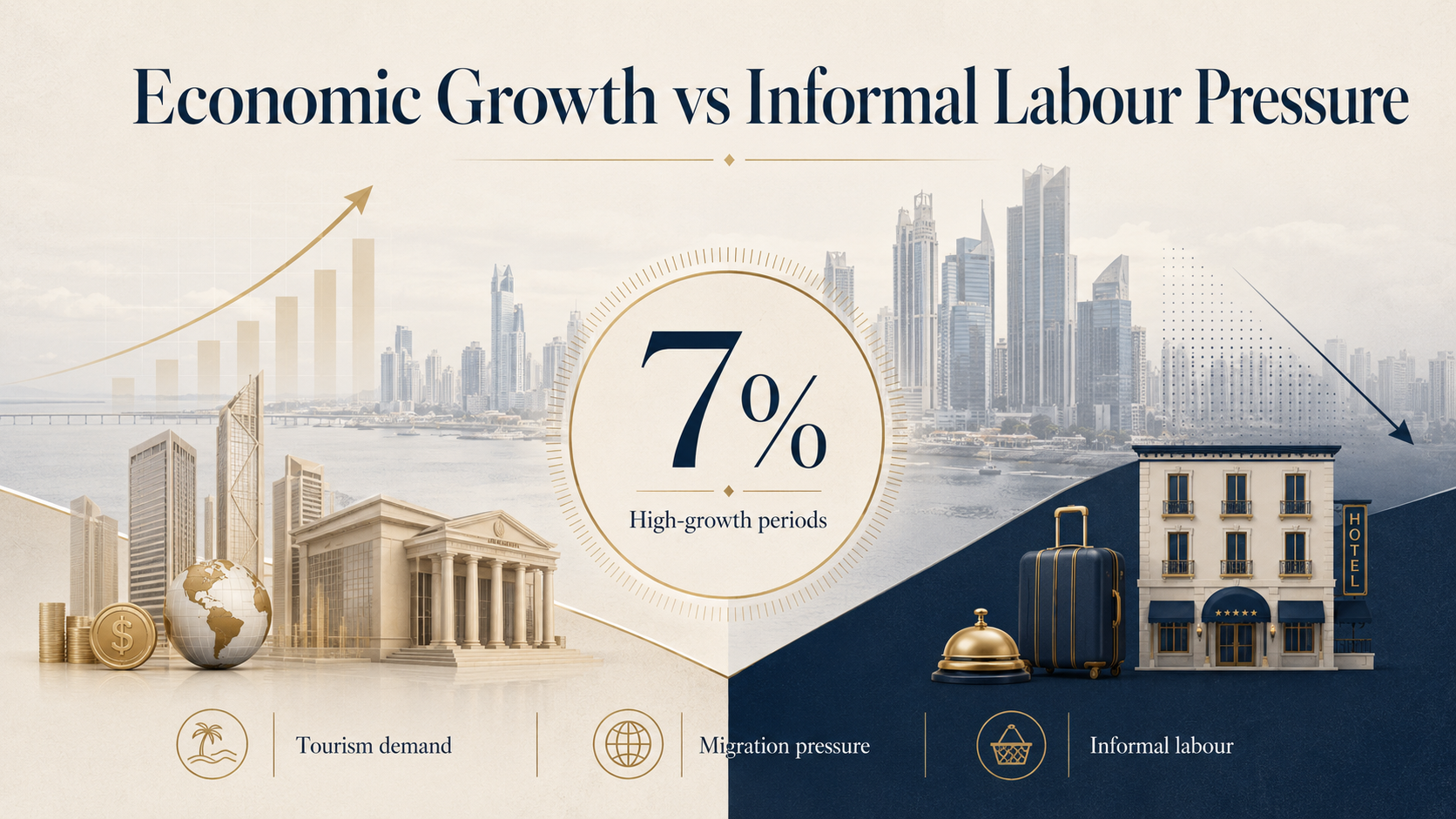
Panama’s high-growth periods helped strengthen the country’s financial, tourism, logistics, and hospitality sectors. The same expansion also exists alongside persistent inequality, migration pressure, and reliance on informal labour markets.
The infographic summarises that tension: formal economic growth can increase travel demand and hospitality activity, while vulnerable workers may still remain outside stable employment, registration, and protection systems.
Sources & References
The following sources support the legal, public-health, migration, trafficking, and socio-economic context discussed in this article. Because this subject involves informal markets and changing enforcement conditions, figures should be treated as reported estimates rather than permanent fixed numbers.
-
World Health Organization (WHO) & UNAIDS: HIV and STI data for key populations in Latin America.
Used for public-health context, including HIV and STI prevalence discussions involving sex workers and the general adult population.
View UNAIDS fact sheet -
U.S. Department of State: Trafficking in Persons Report — Panama.
Used for trafficking enforcement context, prosecution challenges, victim protection issues, and Panama’s anti-trafficking framework.
View Panama trafficking report -
National Institute of Statistics and Census of Panama (INEC): demographic and labour-force context.
Referenced for broader migration, employment, and labour-market context where available.
Visit INEC Panama -
UNODC: human trafficking and organised crime reporting for Central America and the Caribbean.
Used for regional context on trafficking, enforcement, migration vulnerability, and criminal exploitation.
View UNODC publications -
Panama Ministry of Health (MINSA): public health and STI monitoring context.
Referenced for public-health context relating to screening policy, health access, and official health-sector oversight.
Visit MINSA Panama
Navigating Panama City’s Legal & Nightlife Landscape
For readers seeking discreet, high-end companionship in Panama, VIP Models provides a more structured alternative to informal nightlife arrangements, with privacy, adult consent, clear communication, and professional coordination at the centre of the process.
Review available Panama companions or read the booking guide before making a private enquiry.
Explore Panama Escorts Booking GuidanceRequest Private Panama Guidance
Share your preferred date, city, hotel or residence area, and the type of discreet guidance you need. The team will review your request privately.